Goat Funded Trader Rules, and Is Any Challenge Free?
Goat Funded Trader rules in GFT's own numbers: drawdown, profitable days, Goat Guard, consistency, leverage, and what the $1 account really is.
There is no free Goat Funded Trader challenge. Their monthly trading competition is free to enter, and the cheapest paid routes are the Goat 1$ model, a $1,000 funded account priced at $1, and the Pay Later model, which their help centre describes as "a 1-phase evaluation challenge with a $5 entry fee" followed by an activation fee once you pass.
The numbers here are Goat Funded Trader's own, checked on goatfundedtrader.com on 2026-10-07. GFT writes several rules in the form "X for accounts purchased from <date>", so two traders on the same model can sit under different limits. Find your own purchase date in their model article before you trust any summary of these rules.
What are Goat Funded Trader's rules?
The rules that repeat across their models are a profit target per step, a daily drawdown, a maximum overall loss that is either static or trailing, a minimum number of profitable days, a cap on daily profit once funded, a consistency rule on some models, Goat Guard on most funded accounts, and leverage caps by instrument class.
Their help centre documents each model with the rule names beside the values, and the line-up runs from 1 Step and the 2-Step family through 3 Step, Pay Later, GOAT Blitz and the instant funding models. These three cover the questions people ask most:
| Rule | 1 Step | 2-Step Standard | Goat 1$ |
|---|---|---|---|
| Access | Evaluation, one step | Evaluation, two steps | Immediate Funded |
| Profit target | 10%, none once funded | 10% then 5%, none once funded | None |
| Daily drawdown | 4%, and 3% for accounts purchased from 1 August 2026 | 5% | 3% (Static) |
| Max overall loss | 6% (Static) | 10% (Static) | 6% (Trailing) |
| Minimum profitable days | 3 Days | 3 Days | 3 Profitable Days (Per Payout) |
| Max daily profit | No Limit in evaluation, $3,000 funded | No Limit in evaluation, $3,000 funded | Not published |
| Consistency rule | No | No | Yes, 15% |
| Goat Guard | No in evaluation, Yes once funded | No in evaluation, Yes once funded | No, excluded as instant funding |
| Profit split, default | 80% | 80% | 80% |
| Payout cycle | Every 14 days | Every 14 days | Every 14 days |
The dated carve-outs sit on top of that table. On 1 Step the daily drawdown carve-out applies to both phases, evaluation and funded alike, since the rule table carries the same pair of values in both columns: "For 1-Step accounts purchased from August 1st, 2026 onward, the Daily Drawdown Limit is 3% instead of 4%."
Profitable days move by date too: 4 days for 1 Step accounts purchased from 27 July 2026, and 4 days for 2-Step Standard accounts purchased from 25 July 2026, in both cases per payout once funded.
The rewards side, as published
Their 1 Step article documents the funded stage in the same label-and-value style. Profit split: 80%, which they gloss as the trader keeping 80% of their profit. Payout cycle: bi-weekly, every 14 days. And a cap on the way in: "Initial 2 Payout Caps: For the first two payouts, withdrawals are capped at 6% of the initial account size or $10,000 (whichever is lower). This restriction is removed after the 2nd successful payout."
That cap has a dated carve-out of its own on the two-step side, and it moves the percentage rather than the dollar ceiling: "Exception: For $5k Two-Step accounts, the cap is 4% of the initial account balance instead of 6%. This applies only to accounts purchased from July 25th, 2026 onward."
The $3,000 daily profit cap does not end an account. Their note on it: "Profits exceeding this are deducted but do NOT result in an account breach."
Read 80% as the documented default rather than the number a trader ends up on, because two published rules move it in opposite directions. Under their optional add-ons available at checkout they list a 100% profit split, and also "On-Demand First Reward: Receive a 40% split after only 3 days of trading on the funded account." In the other direction, a first Goat Guard trigger cuts the split to 50%.
Is there a free Goat Funded Trader challenge?
No. No model on their help centre is free, and the $1 model costs a dollar rather than nothing.
What is free is their trading competition. Their FAQ answers it directly: "Yes, it is completely free to participate in our trading competition." On timing: "It starts on the first day of the month and ends on the last day of the month." On signing up: "Register for your GFT account with your email. No payment required." The top 20 traders on the leaderboard win each month, the prizes run from cash, which their own page puts at up to $5,000 in a single competition, through consumer electronics to funded accounts, and they also draw ten random participants.
Two of their competition rules are looser than their challenge rules, and they say so in the same FAQ: "Yes, you can trade during news events." And: "Yes, you are allowed to hold trades overnight and over the weekend."
Their help centre documents the rules but not the fees, and the prices live in a configurator on their model page beside promotional codes that change from week to week. The one price their help centre does publish is Goat 1$ at $1, and Pay Later's $5 entry fee. For the rest, their own configurator is the only figure worth trusting on the day you buy, and it is worth checking the discount it actually applies against the one the banner advertises.
What is the Goat 1$ account?
A $1,000 immediate-funded account that costs $1. It is what people are usually looking for when they search for a free GFT account, and it is worth reading the whole rule set before treating it as one.
Their model article documents it as access type Immediate Funded, account size $1,000, price $1, daily drawdown 3% (Static), max overall loss 6% (Trailing), minimum profitable days 3 per payout, a maximum loss rule of 2% Floating Loss, a consistency rule of Yes at 15%, a profit split of 80% and a reward cycle of every 14 days.
Four more published limits decide what the dollar buys: account expiry 28 days after activation, a minimum withdrawal of $100, a maximum lifetime withdrawable profit of $100, and a purchase limit of one account per user. So the most this account can ever pay out is $100, inside four weeks, and you can hold one. Their own gloss on that ceiling: "the total profit you can withdraw is limited to 10% of the initial account balance."
It is also stricter than the models above it in two ways. The overall loss trails instead of sitting still, and it carries the consistency rule, while 1 Step and 2-Step Standard are both documented as No.
What is the daily drawdown, and what is the max loss?
The daily drawdown is 4% on 1 Step, 5% on 2-Step Standard and 3% on Goat 1$, with the dated 3% carve-out on 1 Step noted above. The maximum overall loss is 6% static on 1 Step, 10% static on 2-Step Standard and 6% trailing on Goat 1$.
They set the daily figure in two steps. First, in their words: "At 5:00 PM EST, we check the higher value between the Account Balance or Account Equity." Then they take the model's percentage off that figure, and the result is the next trading day's Daily Drawdown Threshold.
Their worked example takes a balance of $105,000 and equity of $107,000, uses the equity because it is the higher of the two, and takes 4% of $107,000, which is $4,280, for a floor of $102,720 for that day. Starting from the higher of balance and equity cuts both ways: an open winner raises tomorrow's floor along with today's room.
The static limit is the simpler one. On 1 Step: "Your account equity or balance must never drop below 94% of your starting capital", which on a $100,000 account is a floor of $94,000 that never moves.
Trailing behaves differently: on Goat 1$ the percentage follows your equity rather than staying a fixed number of dollars. Their words: "The maximum total drawdown for Goat 1$ accounts is a trailing drawdown set at 6% of the equity value at the end of each trading day." Their example on a $1,000 account: close a day at $1,040 and the limit becomes $977.60, which is 6% below that equity. Drop to $1,030 the next day and the limit stays $977.60, because it never moves down.
$977.60 is below the $1,000 you started with. Once you have had a good day, the level that ends the account is under your opening balance, so you can breach while still being up on the account overall. A static 6% cannot do that to you.
What counts as a profitable day?
A day only counts if you made money on it. Their minimum profitable days article: "To count as a Minimum Profitable Day, the trader must generate a minimum profit of 0.5% of the initial account balance, net of fees and commissions."
Their worked example uses a $100,000 balance, where 0.5% is $500, so the day counts only if the trader makes at least $500 during it. The same page adds: "Your profitable day count resets after each payout." And: "A new trading day starts at 5 PM EST."
Net of fees and commissions is the part that catches people. A day that made $520 gross on a $100,000 account and paid $30 in commission did not produce a profitable day.
Their list has two exceptions to the 0.5% rule, pulling in opposite directions. Under their heading for models requiring trading days without it sits "Instant Standard Model: 7 Trading Days", with no minimum profit needed for a day to count toward those seven. Under a second heading sits the 3 Step model, which has no trading-day requirement at all during its evaluation phases. Everywhere else on the list, a day has to be a winning day.
GFT is precise about the clock: "A new trading day starts at 5:00:01 PM EST and runs until 4:59:59 PM EST the next day." The day a trade belongs to is the day it closed, not the day it opened: "A trade counts toward the trading day in which it is closed. A trade closed after 5 PM EST counts toward the next day's trading day." Their own examples make it concrete, with a trade closed Monday at 4 PM EST counting toward Monday and one closed Monday at 6 PM EST counting toward Tuesday. Their consistency article applies the same boundary to partial closes.
That boundary can cost you a profitable day without you noticing. Hold a winner past 5 PM EST and its profit lands on tomorrow, which may leave today short of 0.5% and tomorrow carrying profit it did not need.
What is Goat Guard?
Goat Guard is a floating-loss limit on open positions. Their page describes it as "GFT's risk management system designed to protect traders from excessive losses and encourage disciplined risk management", and says what it watches: "It monitors the combined floating PnL of your open positions and is triggered when they reach a combined floating loss equal to 2% of your initial account size."
The measurement base is unusual, and they are explicit about it: "The 2% is always measured against the initial size of your account. It is not measured against your current balance, and it is not measured against your equity." They add that the threshold "is therefore a fixed amount for the life of the account." Their example: a $5,000 account has a $100 threshold, and when the balance grows to $5,136 the threshold is still $100. In their words, "It does not become $102.72."
The first trigger does not breach the account. You are notified, positions stay open, the account stays active, and your profit split is reduced to 50%.
On the second trigger their page gets specific. A trigger takes a snapshot of every position open at that moment, and while that exact group of positions is unchanged, "those positions continuing to fluctuate below the 2% threshold will not cause another trigger." Close one of them, or open a new one, and you have a new snapshot. And then: "Important: After your first trigger, any new qualifying trigger will result in the account being breached."
What ends the account is the next change to the set of open positions followed by another 2% floating loss, which can happen minutes later on the same afternoon.
On scope, their own sentence: "Goat Guard applies to all funded accounts excluding Instant Funding, GOAT Blitz and Pay Later accounts." Those excluded models get the harsher version instead, and their page is blunt about it: "a floating loss of 2% of the initial account balance is a hard breach and the account is permanently closed." Because Goat Guard does not reach those models, there is no first trigger to soften the landing. Goat 1$ works the same way, under its own label: "If your floating profit and loss (PnL) drops below -2% of your account balance at any moment, the account will be permanently closed", which on a $1,000 account is a combined open loss of $20.
The same 2% number, then, means a halved profit split on a 1 Step funded account and an immediate closure on Goat 1$.
Is there a consistency rule?
On some models. Their consistency article defines it as: "The Consistency Rule means that no single trading day can account for X% or more of your total profits during the payout period."
The percentage is not fixed. Their page says it may vary depending on the challenge or funding model, and 1 Step and 2-Step Standard are both documented as No while Goat 1$ is documented as Yes at 15%. Their worked example at 15% pairs a total profit of $5000 with a ceiling of $750 on the best single day. The Goat 1$ article works the same rule on its own scale: a $15 day needs $100 of total profit behind it.
Failing it is not a breach. Their page: "Not meeting the Consistency Rule will not result in account termination or an account breach. However, you will not be able to request a payout until your highest profit day is below X% of your total profits for the payout period." Partial closes count on the day each part closed, so splitting an exit across two days splits the profit across two days for this rule, which is one legitimate way to bring a lopsided day back inside the limit.
What leverage do you get?
Maximum evaluation leverage is 1:100 on forex, 1:20 on indices, 1:20 on commodities, 1:2 on crypto and 1:5 on stocks. On funded accounts the initial figures are 1:50 forex, 1:10 indices, 1:10 commodities, 1:2 crypto and 1:5 stocks.
Their leverage page also says: "Max Leverage is applied to all phases of the Evaluation." They describe the lower funded leverage as a starting point that rises again depending on how a trader manages risk.
What happens if you stop trading?
The account breaches. Their inactivity page: "If no trades are placed on your account for 30 consecutive days, it will be breached due to inactivity. This rule applies to both Evaluation and Simulated Funded Accounts." Once breached, it cannot be reinstated, and the fee is not refunded. They suggest a trade every 29 days as a buffer, and note that the profitable-day requirements apply only when progressing an account or requesting a payout, so inactivity is a separate clock from those.
How do you know your strategy would survive these rules?
By scoring trades you have already taken against the rules before an entry fee is involved. That is what the Prop Firms scorer in ChartLabs does, and Goat Funded Trader is one of the firms in its catalog.
The way it works: you backtest a strategy by hand, then the scorer takes those closed trades, turns them into a return stream and re-simulates that stream against each challenge's published rules. It checks the profit target, the daily loss limit, maximum drawdown including static, trailing and trailing intraday, minimum trading days, consistency rules, time limits and weekend holding rules. Each challenge comes back as Pass, Almost, Not yet or Failed, with the single rule that held you back named next to the verdict. The catalog is maintained by us and is read only, so you are scored against the firms' rules rather than something you configured.
There is a risk per trade slider above the results, and moving it re-scores everything, because the same trades sized differently produce a different equity curve. That matters here because GFT's static and trailing limits fail at different sizes.
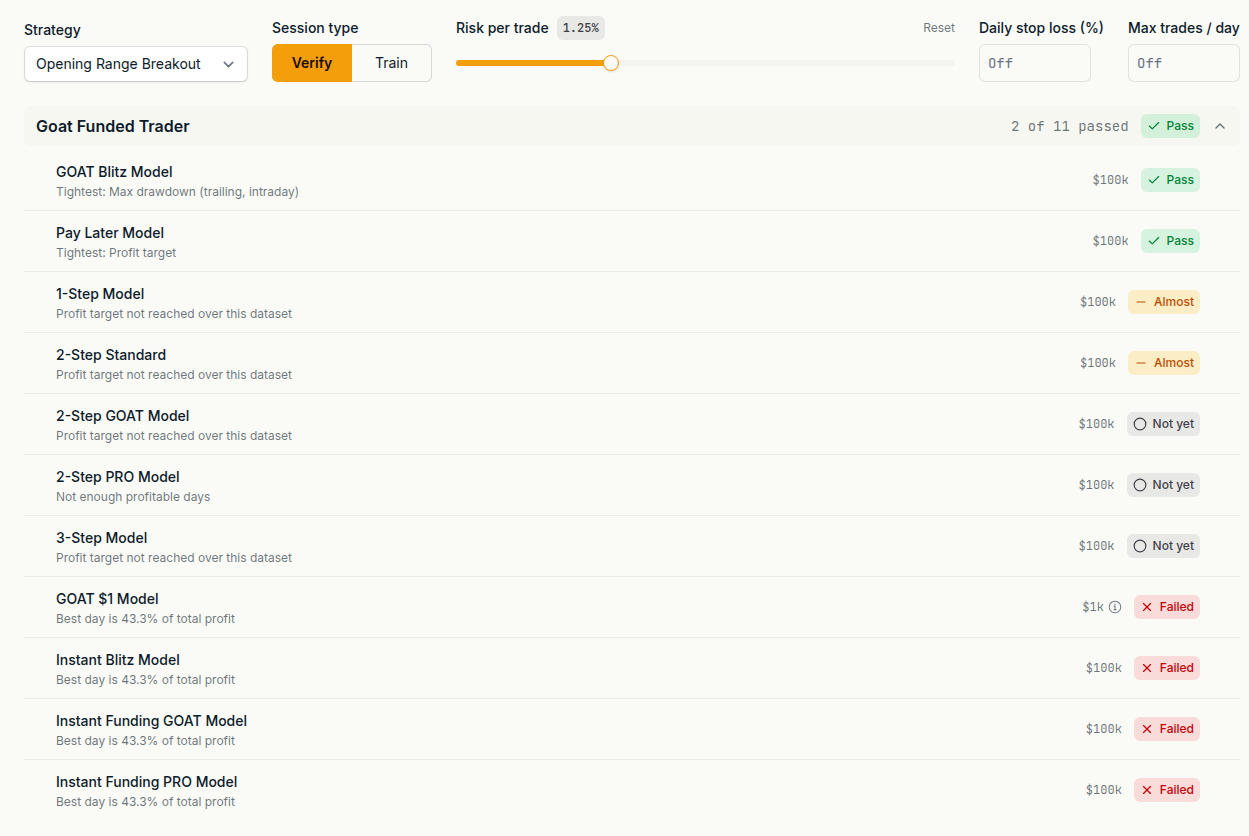
Goat Guard watches floating loss on positions that are still open, and its snapshot mechanic depends on when you opened and closed each one. A backtest scores the trades you closed, so a rule of that kind is about how you hold a trade rather than only about the trades you ended up with. Nothing in ChartLabs reproduces Goat Guard. The drawdown, daily loss, profitable day and consistency rules are the ones a closed-trade record can answer, and on GFT's models those are the rules that decide most attempts.
If you want to see what a percentage limit means in money on your own account size first, there is a drawdown calculator: its own page takes a daily loss limit measured either from the initial size or from the start-of-day balance, a static or trailing max loss, and shows which losing trade in a row breaks each one.
More on the scorer in Prop Firm Backtesting. If you have never run a manual backtest before, start with Backtesting a Trading Strategy, and Forex Backtesting covers the data side.
Next step
Score your own backtested trades against the rules before you pay for anything. ChartLabs is $20 a month or $200 a year, one plan with everything included, and the trial is 7 days with no credit card: start the free trial.
Related Topics
Related Guides
Prop Firm Backtesting: See Which Challenges Your Strategy Would Pass
ChartLabs re-scores your backtested trades against real prop firm challenge rules, so you can see which challenges your strategy would pass and what sizing would change that. It is a scorer, not a funded account: ChartLabs does not connect to a prop firm, place live trades, or provide funding.
Backtesting a Trading Strategy: A Beginner's Guide
What backtesting is, why it matters, and how to run one step by step: defining your rules, choosing clean historical data, stepping through the chart trade by trade, logging results, and reading the metrics that tell you whether your strategy has a real edge.