E8 Markets Free Trial? The Rules of Each Account
Is there an E8 Markets free trial? No, every route is paid. E8 One, Pro and Signature rules, prices, and Dynamic Drawdown against a trailing limit.
E8 Markets publishes no free trial and no free challenge. Every route in is paid, and the cheapest list price is $32, for a $5K E8 Pro account.
E8's drawdown rules differ by product. Their flagship uses something they call Dynamic Drawdown, which is neither a static limit nor the equity-trailing limit most firms use: it moves up only on profit you have closed. A second product is flatly static. A third moves once a day, on your highest daily balance. Which one you bought changes which strategies survive.
The numbers here are E8's own, checked on e8markets.com on 2026-10-07, and they cover their Classic Markets line, which they list as forex, commodities, indices and energies. E8 also sells a futures product and 24/7 perpetuals, each with its own rules, and none of those numbers appear here.
What is E8 Markets?
A firm selling simulated evaluation accounts, by their own description. Their site footer says E8 Funding LLC "provides access to trading accounts within a simulated environment", that "These accounts are for educational use only, evaluating users' trading proficiency and risk management skills", and that "At no time are users asked to deposit capital for investment purposes, nor do they risk their own funds."
The site states it operates under Digital Renaissance LLC, a company incorporated in Puerto Rico, with E8 Funding LLC listed in Dallas, Texas. They name Tradelocker, cTrader and Match Trade as the platforms they operate. One line from the same footer belongs with the prices: payments "are for access to educational software and services, and are non-refundable unless unused."
What are the three accounts, and how do they differ?
Three products, and their own comparison page describes each in one line:
| Account | Their own one-line description |
|---|---|
| E8 One | "Most customizable product · Pass in one day · Uncapped earnings" |
| E8 Pro | "Daily payouts · Static drawdown · No payout caps" |
| E8 Signature | "Cheapest option · Pass in one day · Softer rules" |
E8 Pro is the static-drawdown product, advertised as such, while E8 One, their flagship, uses Dynamic Drawdown and E8 Signature uses an end-of-day limit. The loss limit is where these three differ most, and all three publish their own rule table.
E8 Pro, the static one
Their own summary: "An 8% static drawdown that never trails, an 8% profit target, and payouts you can request every single day." Their stat block reads a profit target of 8%, a static drawdown of 8%, and a consistency rule of None.
The static rule itself, under their own heading: "Max loss is locked 8% below the initial balance. It never trails your equity."
Their rule table carries two more numbers that the summary leaves out, and the first of them is a hard breach:
| Rule | Challenge stage | Performance stage |
|---|---|---|
| Profit target | 8% | none |
| Static drawdown | 8%, "Calculated from the initial balance. Never trails. Hard breach." | 8%, "Same as challenge. After your first payout it locks at the initial balance permanently." |
| Daily loss limit | "2.5% of initial balance. Hard breach." | 2.5%, same as the challenge, hard breach |
| Daily profit cap | 2%, "Only 2% per day counts toward your target." | 2%, "The 2% cap still applies on the performance account." |
| Payout | "Choose 80% or 100% at purchase" | |
| Consistency rule | None | None |
On a $100K account their configurator showed those as a profit target of $8,000, a static drawdown of $8,000, a daily drawdown of $2,500 and a daily profit cap of $2,000.
The daily profit cap is the one people miss, because it is not a loss rule. Only 2% of a day's gain counts toward the 8% target, so four maximum days is the arithmetic floor on passing this product. That is why E8 advertise passing in one day on their other two accounts and not on this one.
On payout timing they are specific: "One performance-based payout request per day after rollover. No two-week waits." Their rule table adds the condition, "Request daily with 1% minimum profit."
E8 Signature vs E8 One: which is which?
E8 One is the configurable one. E8 Signature is the cheap one at a matched account size, and it is forex only.
E8 Signature now publishes a full rule table, and its loss limit is a third shape again: an end-of-day limit that moves with your highest daily balance rather than with your equity or your closed profit.
| Rule | Challenge stage | Performance stage |
|---|---|---|
| Profit target | 6% | none |
| EOD dynamic drawdown | 3 to 4%, "Based on your highest daily balance, updated once per day at market close." | 3 to 4%, "Same end-of-day limit as the challenge stage." |
| Daily pause | 2%, "A soft daily loss limit based on your starting balance of the day." | |
| Best-day rule | none | 35%, "No single day may exceed 35% of your total generated profits." |
| Payout | 80% | |
| Trading days | Unlimited, with at least one trade every 60 days | same |
| Leverage | "Forex 1:30 · Indices & metals 1:15." | |
| Payouts | "5 profitable days between payouts (not the first), $100 minimum. A profitable day is realized PnL of 0.3% or more." |
Their configurator, set to a $100K account at 3% drawdown, showed a profit target of $6,000, an EOD Dynamic Drawdown of $3,000 and a Daily Pause of $2,000. Their FAQ gives the limit in money across the range too: it "scales with account size, from $1,000 on a $25K account to $4,500 on a $150K account."
Those two figures are 4% of $25,000 and 3% of $150,000, which is how the 3 to 4% range resolves. The small account carries the wider percentage, not the choice of one.
Two rules decide what you can take out. The buffer, in their words: "Before you can start requesting a payout, you need to leave a buffer in your account of the same size as your EOD dynamic drawdown." And a cap per request, which rises as you take payouts:
| Payout | $25K | $50K | $100K | $150K |
|---|---|---|---|---|
| 1st and 2nd | $1,000 | $1,250 | $2,250 | $3,250 |
| 3rd and 4th | $1,250 | $2,250 | $3,250 | $4,250 |
| 5th onward | $1,500 | $3,250 | $4,250 | $5,250 |
What are E8 One's rules?
Their rule table gives ranges, because you choose your own drawdown and the target follows from it.
| Rule | Challenge stage | Performance stage |
|---|---|---|
| Profit target | 1.5 times the drawdown you choose, range 6 to 21% | none |
| Dynamic drawdown | "Trails on closed profits", 4 to 14% | Same as the challenge, 4 to 14% |
| Daily drawdown | Hard breach, 3 to 9.2% | Same as the challenge, hard breach |
| Trading days | "Unlimited trading day. No minimum." | |
| Payout split | 80%, 90% or 100%, chosen at purchase and permanent | |
| Best day consistency rule | none | "No single day may exceed 40% of total profits." |
Because the target is a formula, the figures are checkable. Their configurator, set to a $100K account at 6% drawdown, showed a profit target of $9,000, Dynamic Drawdown of $6,000 and a daily drawdown of $4,000. Six per cent of $100,000 is $6,000, and 1.5 times that is 9%, which is $9,000. The published rule and the displayed figures agree, and the range holds at both ends: 1.5 times the minimum 4% gives the 6% floor, and 1.5 times the maximum 14% gives the 21% ceiling.
Their permissions are open, in their words: "Expert Advisors and weekend holding allowed" and "News trading allowed during challenge". On markets, they describe E8 One as being for traders who want to trade "Forex, Indices, commodities, or Crypto without any payout limitations". Other firms restrict at least one of those.
What is Dynamic Drawdown, and how is it different from trailing drawdown?
It is a maximum loss level that moves up only when you close a profitable trade. Floating profit does not move it.
Their own explanation: "Traditional Trailing Drawdown moves with the trader's equity; however, our Dynamic Drawdown loss level will only increase when you are closing profits. Meaning, we count what you keep, not what you almost had. Swing traders are not punished for floating P&L while they hold a profitable trade." Their feature list adds: "This is not traditional Trailing drawdown."
Maximum loss rules come in several shapes. E8 sells a static product, a closed-profit product and an end-of-day product side by side, and names the traditional equity-trailing kind itself to distinguish its own from it:
| Kind | What moves the level | Where the wording comes from |
|---|---|---|
| Static | Nothing. It sits a fixed distance below your starting balance. | E8 Pro, "locked 8% below the initial balance" |
| Trailing on equity | Any rise in equity, including unrealised profit on an open trade. | E8's own description of the traditional kind |
| Trailing intraday | Equity within the day, which can breach on a spike and recover. | A variant scored separately in our own tool |
| End of day | Your highest daily balance, recalculated once a day at the close. | E8 Signature, "updated once per day at market close" |
| Dynamic, as E8 defines it | Only profit you have closed. | E8 One |
None of those is better than the others. Each punishes a different habit. An equity-trailing limit is hardest on a trader who lets a winner run and then gives part of it back, because the level followed the peak. E8's version is easier on exactly that trader and no easier on someone who banks a good week and then loses it, because closed profit does move the level. Their static product never moves, which suits a trader who wants the breach level known on day one. Signature's moves once a day, so a spike inside the session does not ratchet it.
Our Prop Firms scorer checks maximum drawdown in its static, trailing and trailing intraday forms. A limit that trails closed profit only is none of those three, and neither is one that only moves at the close, so those two rules are E8's own and we do not reproduce them.
For the two plain shapes there is also a drawdown calculator. Its own page describes a daily loss limit measured either from your initial account size or from your balance at the start of the day, a static max loss as "A fixed floor at your initial size minus the max loss", and a trailing one where "The floor follows your highest closed balance". It shows which losing trade in a row breaks each limit.
What is the daily drawdown?
A separate hard limit on every product, and the number depends on which one you bought: 3 to 9.2% on E8 One depending on how you configure it, a flat 2.5% of the initial balance on E8 Pro, and on E8 Signature a 2% daily pause that their own table calls soft rather than a breach.
On the $100K accounts their configurator showed those as $4,000 for E8 One at 6% drawdown, $2,500 for E8 Pro and $2,000 for Signature.
E8 One's table marks it "Hard breach" in both stages, so hitting it ends the account rather than pausing it, and E8 Pro's says the same. It applies alongside the maximum loss rule rather than instead of it, so a strategy has to stay inside both.
What is the best day rule?
E8 publish one on two of the three products, at different percentages, and only in the performance stage.
On E8 One their label is the Best day consistency rule, and the rule is "No single day may exceed 40% of total profits." On E8 Signature it is 35%: "No single trading day can exceed 35% of your total generated profits." E8 Pro carries none at either stage.
Which stage it applies to matters more than the number. From the E8 One FAQ: "There is no consistency rule in the challenge phase, but in the performance stage, there is a 40% best day rule. With a 40% Best Day Rule, you must ensure that no single trading day exceeds more than 40% of your total generated profits." Their challenge section says the same from the other direction: "In the challenge stage (Phase-1), there are no profit caps or consistency rules, meaning you can pass your challenge in one day."
So one big day can carry you through the challenge and then cause you a problem at payout time.
How fast can you pass, and how fast is the first payout?
On E8 One, in a day, on their own account of it: "you can pass your challenge in one day", which follows from having no minimum trading days and no consistency rule in the challenge stage. Their configurator advertises the same on Signature.
On payouts, their published rule for E8 One: the first is "Available after 3 calendar days of trading", and after that they are on demand, "as soon as 3 days". Their FAQ words it as the earliest request being "3 days after starting trading in the Performance stage, as long as all requirements are fulfilled". Their configurator also showed "No Activation Fee" on all three accounts configured above.
E8 Pro is the exception in both directions. Its cadence is daily rather than every three days, one request per day after rollover with 1% minimum profit, and its configurator showed a first payout in as little as 0 days. But its 2% daily profit cap means the challenge itself cannot be done in one day.
Signature sits in between: a first payout in as little as 3 days, then five profitable days between payouts, where a profitable day is realized PnL of 0.3% or more.
What does it cost?
Their list prices, before any promotion. Blank cells are sizes that product is not sold in.
| Account size | E8 One | E8 Pro | E8 Signature |
|---|---|---|---|
| $5K | $48 | $32 | |
| $10K | $88 | $68 | |
| $25K | $188 | $148 | $120 |
| $50K | $288 | $228 | $160 |
| $100K | $488 | $488 | $280 |
| $150K | $450 | ||
| $200K | $798 | $998 | |
| $400K | $1,598 | $2,098 | |
| $500K | $1,998 | $2,598 |
Their "Cheapest option" line for Signature holds at a matched account size and not at the entry: Signature's smallest account is $25K at $120, where E8 Pro starts at $32 for a $5K. Above $100K the ranking inverts again, and E8 Pro becomes the dearest of the three.
A 30% discount was running on all three, shown as a struck-through price beside each one, which brought the $5K E8 One to $34, the $500K to $1,399 and the $100K Signature to $196. A seasonal banner on the same pages advertised a larger headline figure at once, "Up to 50% off, in October", under a different code from the one the configurator was applying. Two of their own numbers disagree, so check the configurator for the price on the day. Their footer adds that payments are "non-refundable unless unused", which is a different arrangement from the firms that refund a challenge fee with an early payout.
How would you know whether your strategy survives these rules?
By scoring trades you have already taken against the published limits before you pay anything. That is what the Prop Firms scorer in ChartLabs does, and E8 Markets is one of the firms in its catalog.
You backtest a strategy by hand, then the scorer takes those closed trades, turns them into a return stream and re-simulates it against each challenge's published rules: profit target, daily loss limit, maximum drawdown including static, trailing and trailing intraday, minimum trading days, consistency rules, time limits and weekend holding. Each challenge comes back as Pass, Almost, Not yet or Failed, with the single rule that held you back named beside the verdict. The catalog is maintained by us and is read only, so you are scored against the firms' own rules.
The risk per trade slider above the results re-scores everything when you move it, because the same trades at a different size make a different equity curve. On a rule set where the loss limit moves as you bank profit, sizing is most of the question.
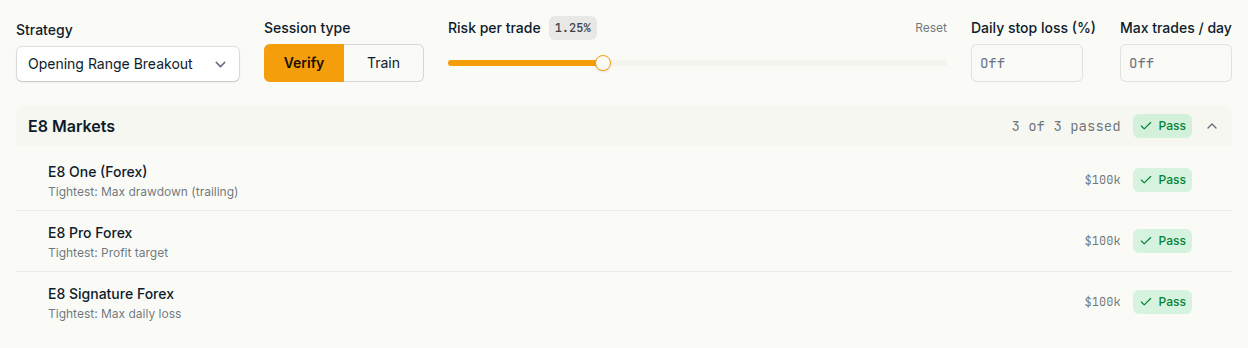
The E8 One verdict in that picture is a guide rather than an answer. Dynamic Drawdown depends on when you closed each profit, so it is sensitive to the order of your trades and not only to their results. A hand-run backtest does give you that order, but our scorer measures the E8 One rule set with a standard trailing limit instead of E8's own. Signature's end-of-day limit has the same gap. The best day rule has a different shape again: it asks how your profit is spread across days rather than what it added up to.
Where the scorer is on firmer ground with E8 is the static and daily limits, which are plain percentages of a starting balance, and the profit target, which is arithmetic on closed trades.
More on the scorer in Prop Firm Backtesting. Backtesting a Trading Strategy covers testing by hand, and Forex Backtesting covers the data side.
A note on dates
Prop firms change rules, prices and promotions. On E8 the discount, the market line on their feature lists and Signature's whole rule table have all changed. Treat their configurator as current and the figures above as a snapshot.
Next step
Score your own backtested trades against their limits before you pay an entry fee. ChartLabs is $20 a month or $200 a year, one plan with everything included, and the trial is 7 days with no credit card: start the free trial.
Related Topics
Related Guides
Prop Firm Backtesting: See Which Challenges Your Strategy Would Pass
ChartLabs re-scores your backtested trades against real prop firm challenge rules, so you can see which challenges your strategy would pass and what sizing would change that. It is a scorer, not a funded account: ChartLabs does not connect to a prop firm, place live trades, or provide funding.
Backtesting a Trading Strategy: A Beginner's Guide
What backtesting is, why it matters, and how to run one step by step: defining your rules, choosing clean historical data, stepping through the chart trade by trade, logging results, and reading the metrics that tell you whether your strategy has a real edge.