FTMO Challenge: Swing vs Standard (Normal) Account
FTMO Swing vs normal account in FTMO's own words: news, weekend and overnight rules, leverage, and which Challenge sells the Swing type.
The Swing account type removes FTMO's restrictions on trading through selected news releases and on holding positions overnight or over the weekend, and in exchange its leverage is set lower. The Standard type, which traders usually call normal, keeps those restrictions and the higher leverage.
FTMO states both of the points that decide this plainly on its own FAQ: the news and holding restrictions do not apply during the Evaluation Process, and the Swing type is sold with only one of the two Challenge products. FTMO's rules below were checked on ftmo.com on 2026-10-07. These are FTMO's rules for their CFD product; they sell a separate futures product with its own rules, and our own catalog has no futures contracts in it.
What is the difference between an FTMO Swing account and a Standard (normal) account?
Restrictions and leverage. FTMO's Swing FAQ says: "The FTMO Swing account type does not have any restrictions on trading during news releases or on holding positions overnight (longer than 2 hours after market close) or over the weekend." The Standard type has both restrictions once you reach an FTMO Account, and it gets the higher leverage of the two.
FTMO describes who the Swing type is for: "suitable for swing traders who need to hold positions for longer periods of time and allow trades sufficient time to develop", and "typically used by fundamental traders who expect market sentiment to persist for several days or weeks, or by technical traders who analyse higher timeframes".
| Standard (normal) | Swing | |
|---|---|---|
| News release restriction | yes, on an FTMO Account | none |
| Holding overnight or over the weekend | restricted on an FTMO Account | no restriction |
| Leverage | "up to 1:100 and cannot be increased" | "up to 1:30" |
| Available on | both Challenge products | "exclusively within the FTMO Challenge: 2-Step" |
| Switch to the other type | never becomes Swing | may become Standard before each new cycle |
Can you trade the news on an FTMO Challenge?
Yes, provided you keep clear of FTMO's Forbidden Trading Practices. FTMO's news FAQ is explicit that the news restriction itself is not part of the evaluation: "For Standard accounts, these restrictions apply only once you start trading on an FTMO Account. They do not apply during the Evaluation Process." During evaluation, on either account type, "You may trade freely during all macroeconomic news releases, provided you do not engage in any Forbidden Trading Practices."
The restriction that arrives later applies to Standard accounts only, and Swing accounts have no news restriction. On an FTMO Account, FTMO states: "On the targeted instruments, it is not permitted to open or close any trades, including the execution of pending orders (such as Stop Loss or Take Profit), within a time window starting 2 minutes before and ending 2 minutes after the release of selected news announcements."
It is narrower than it sounds, because only the affected instruments are covered. FTMO's example: during the US NFP release "you may trade EURGBP or AUDNZD; however, you must not open or close trades on USDJPY or GBPUSD within the time window of 2 minutes before to 2 minutes after the NFP release." FTMO adds: "This rule applies equally to traders who qualified through FTMO Challenge: 1-Step and FTMO Challenge: 2-Step."
Can you trade on the weekend?
Yes, whenever a market is open. FTMO: "We do not have any restrictions on executing trades on weekends. If the market is open, you are free to trade as usual."
Holding a position through the weekend is a different question.
Do you have to close positions overnight or before the weekend?
Not during the evaluation. FTMO: "You are allowed to keep your positions open overnight and over the weekend."
On an FTMO Account it depends on the account type. FTMO: "Overnight and weekend position restrictions apply only to the Standard account type. The Swing account type does not have any restrictions on holding positions overnight or over the weekend." For a Standard account, "you are required to close your positions shortly before the markets close for the weekend or if the rollover (market break) lasts longer than 2 hours."
FTMO says "Trading hours depend on the specific instrument and may vary due to market conditions, holidays, or other events", so the exact closing moment is per symbol rather than a fixed clock time. And their platform server time is given as "MetaTrader 4, MetaTrader 5 = GMT+2 +DST", which is the clock those rules are read against.
Is the Swing account type available on the 1-Step Challenge?
No. FTMO's Swing FAQ states: "The FTMO Swing account type is available exclusively within the FTMO Challenge: 2-Step. When ordering an FTMO Challenge: 2-Step, you can select Swing as your account type during the configuration process."
FTMO's comparison table says the same: its account type row reads "Standard, Swing" for the 2-Step and "Standard" for the 1-Step.
Check that yourself before you buy, because it is not stated the same way everywhere. An FTMO x OANDA blog post in their Product News section, marked published six months ago, says both account types are available within the 1-Step and the 2-Step. That post carries its own disclosure that FTMO US is run through a partnership between FTMO and OANDA, so it is a different offering from ftmo.com's own product. For ftmo.com's Challenge, ftmo.com's own FAQ and comparison table are the pages to trust.
What leverage does each account type get?
Standard gets up to 1:100, Swing up to 1:30. FTMO's account specifications FAQ: "The leverage we offer for the Standard account type is up to 1:100 and cannot be increased. The Swing account type has leverage set to up to 1:30."
The same page adds: "At all stages, you trade with fictitious capital; the leverage is applied to this fictitious capital only." Lower leverage caps the position size you can open against a given balance, and whether that binds you depends on the stop distances your strategy actually uses. Our position size calculator turns a stop distance and a risk percentage into the size that goes with them.
Can you switch from Standard to Swing later?
No. FTMO: "if you purchase an FTMO Challenge as a Standard account type, it is not possible to change it to a Swing account type at a later stage." They say the same about an attempt already running: "Changing the account type to Swing during the FTMO Challenge or Verification stages is not possible."
The other direction is open. An FTMO Trader may move from Swing to Standard: "You may switch an existing FTMO Account Swing to a Standard account type before each new cycle (Reference Period)." FTMO gives the practical moments too, that "you can change your account type from Swing to Standard after each Reward withdrawal, or after signing the FTMO Account Agreement and before placing any trade on the FTMO Account." Their own summary of the pair reads "Change from Standard to Swing: Not allowed" and "Change from Swing to Standard: Allowed".
Buy Swing and the Standard rules stay reachable later; buy Standard and Swing never is.
Which one does your strategy need, and how do you find out before you pay?
Look at trades you have already taken rather than at how you describe yourself. If your closed trades regularly sit open past a Friday close or through a 2-hour market break, the Standard rules would have interfered with them. If they open and close inside a session, the restriction would rarely have touched you.
If you do not have a record like that yet, a manual backtest produces one. In ChartLabs you step through historical charts bar by bar and place trades by hand, which leaves you a set of closed trades with their open and close times attached.
Timing Insights breaks your results down by the hour and the day you opened trades, and the Stats Calendar shows them day by day, so a strategy that only ever opens on Monday mornings looks different from one that opens on Friday afternoons.
The Prop Firms scorer then takes the closed trades from a strategy you backtested and re-scores them against a read-only catalog of real challenge structures. It checks profit target, daily loss limit, maximum drawdown in its static, trailing and trailing intraday forms, minimum trading days, consistency rules, time limits and weekend holding rules. Each verdict is Pass, Almost, Not yet or Failed, and it names the single rule that held you back. A Risk per trade control re-scales the same trades at a smaller or larger size, which shows how much of a result was the rules and how much was sizing.
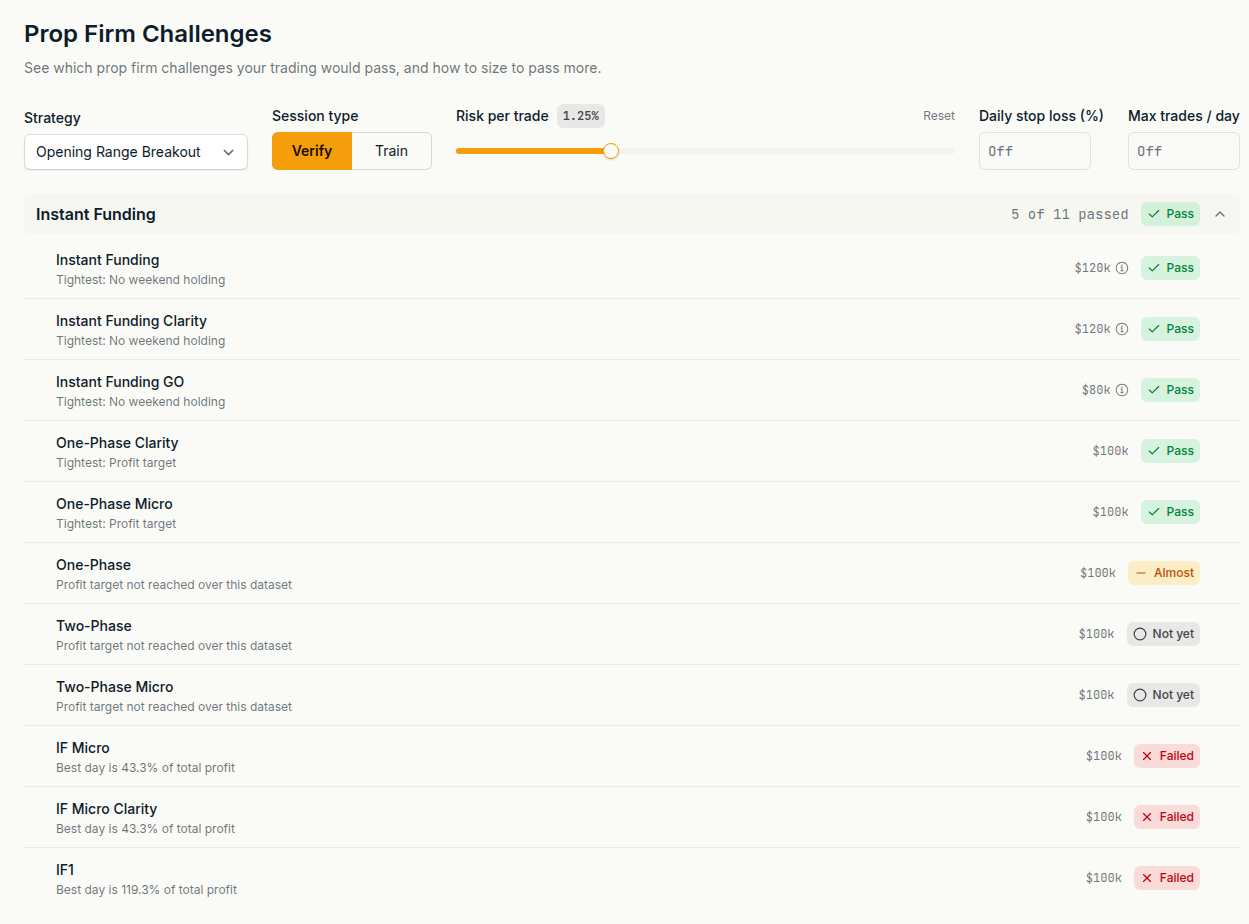
That is a scorer that reads your own backtested trades. ChartLabs does not provide funding, is not connected to FTMO or any other firm, and a pass here is not a pass with anyone.
What is left to check on FTMO's own site
Which type to buy is yours to decide, and it depends on your strategy and your money. FTMO's fees, refund terms and retry costs are also theirs to state, and their own site is the place for those.
The trading objectives themselves, profit target, daily loss, maximum loss and Best Day, are a separate subject with their own numbers, and the prop firm backtesting guide covers how a strategy gets measured against them. If you want your results to survive the comparison, read how slippage and data quality change a backtest first, and if you are new to testing by hand, start with the beginner's guide to backtesting a strategy.
Next step
Build the trade history that answers the question. Start the 7-day ChartLabs trial. No credit card, and the full plan while you test.
Tags
Related Articles
Prop Firm Backtesting: See Which Challenges Your Strategy Would Pass
ChartLabs re-scores your backtested trades against real prop firm challenge rules, so you can see which challenges your strategy would pass and what sizing would change that. It is a scorer, not a funded account: ChartLabs does not connect to a prop firm, place live trades, or provide funding.
Backtesting Accuracy: How Slippage and Data Quality Matter
Why backtest results and live results drift apart, and what actually closes the gap: clean tick data, honest spread assumptions, and commission and slippage modelled directly on every trade you log.
Backtesting a Trading Strategy: A Beginner's Guide
What backtesting is, why it matters, and how to run one step by step: defining your rules, choosing clean historical data, stepping through the chart trade by trade, logging results, and reading the metrics that tell you whether your strategy has a real edge.