FundedNext Rules: The Numbers for Each CFD Model
FundedNext rules for each CFD model, from FundedNext's own pages: profit targets, daily loss, maximum loss, trading days, leverage, prices and fee refunds.
FundedNext does not have one set of rules. It sells four CFD challenge models, and the profit target, the daily loss limit, the maximum loss limit and the minimum trading days are different in every one of them.
The numbers here are FundedNext's own, checked on fundednext.com on 2026-10-07. The models below are the CFD ones: Stellar 2-Step, Stellar 1-Step, Stellar Lite and Stellar Instant. FundedNext sells a separate futures line, Flex, Rapid and Direct, with its own rule sets, and none of those numbers appear here. Every figure comes from FundedNext's own pages. Firms change their rules and their promotions, so treat their pages as current and this as a snapshot.
What are FundedNext's rules?
The four CFD models, from FundedNext's CFD trading objectives page:
| Rule | Stellar 2-Step | Stellar 1-Step | Stellar Lite | Stellar Instant |
|---|---|---|---|---|
| Profit target | 8% Phase 1, then 5% Phase 2 | 10%, single phase | 8% Phase 1, then 4% Phase 2 | No profit target |
| Daily loss limit | 5% of initial balance | 3% | 4% | None |
| Maximum loss limit | 10%, static | 6%, static | 8%, static | 6%, trailing |
| Minimum trading days | 5 per phase | 2 | 5 each phase | None |
FundedNext defines the profit target as "The required profit to pass each phase. Calculated on closed trades only."
Carrying the 2-Step's 10% maximum loss into a 1-Step account leaves you trading as though you had four percentage points more room than the rule allows. Read the row for the model you are actually buying.
What is the daily drawdown on FundedNext?
5% of the initial balance on the 2-Step, 3% on the 1-Step and 4% on Lite. On Stellar Instant their own pages disagree, so treat it as unsettled: the CFD trading objectives page lists "Stellar Instant: No daily loss limit", while the help centre's article on calculating the limit says "For traders participating in FundedNext Challenges, each account type has a fixed daily loss limit." Ask FundedNext which governs an Instant account before you trade one as though it had no daily cap.
FundedNext: "A cap on how much you can lose in a single day. Includes realized and unrealized P&L, swap, and commission. Breaching it closes the account." And: "Set as a percentage of your initial balance based on your account model. Resets daily at 0:00 server time."
Their help centre is blunter about the costs: "When calculating the daily loss, please note that swap charges, commissions, and fees are included in the total amount."
An open losing trade counts against the limit before you close it. The number the rule watches is your equity, not your balance.
Swap, commission and fees count too, so a strategy that trades often eats into the limit through costs alone.
A profit banked earlier in the same day raises your room for the rest of it. Their worked example: on a $100,000 2-Step account with a 5% limit, "At noon (server time), you have made $2,000 profit, so the daily loss limit for that day will be ($100,000 x 0.05 + $2,000) = $7,000." That extra room disappears at the reset. In their words, "After the reset, previous day profits will no longer count toward your daily loss limit."
The reset is on their clock, not yours: "Please keep in mind that your daily loss limit will reset every day at 00:00 (server time)." Their server moves with the seasons. "During daylight saving time, which typically occurs during the summer months, the server time is set to Greenwich Mean Time (GMT) +3." And "For the remainder of the year, when daylight saving time is not in effect, the server time is adjusted to GMT+2."
Midnight at GMT+3 is 21:00 UTC, and midnight at GMT+2 is 22:00 UTC. New York sits at UTC-4 in summer and UTC-5 in winter. Both land on 5 PM in New York. So the clock label changes twice a year and the moment does not: the trading day flips at the New York afternoon in either season, and a session that straddles it is two different trading days as far as the rule is concerned.
A 5% daily limit on a $6,000 account is $300, and 3% is $180. The drawdown calculator does that for your own size, and the position size calculator turns the limit into a lot size.
What is FundedNext's max loss limit, and is it static or trailing?
10% on the 2-Step, 6% on the 1-Step, 8% on Lite, all static. Stellar Instant is 6% and trailing.
FundedNext defines it as "A cap on how much you can lose across the lifetime of your account. Calculated as a percentage of the initial balance, fixed per account model. Breaching it closes the account."
And the two kinds, in their words: "Static means the loss limit is set from your starting balance and remains unchanged throughout. Trailing means the loss limit rises with your profits, does not decrease during losses, and stops once it reaches your initial balance."
Static and trailing fail in different ways. A static limit is a fixed floor, so profit buys you room that stays bought. A trailing limit follows your high water mark up, so a good week moves the floor closer to where you now trade, and giving back that week can end the account while you are still above your starting balance. Instant's trailing stops once it reaches the initial balance, which caps how far it can climb and means the floor never rises above where you began.
FundedNext's help centre states the 1-Step limit as a floor rather than a percentage: "Your account must not drop below 94% of its initial balance, meaning the total loss cannot exceed 6% overall." Those are the same rule written two ways.
What is FundedNext's profit split?
80% of net profit as standard on the challenge models, with more available later, and 70% at the start on Instant.
From the CFD trading objectives page, the standard reward share is "80% of net profit", Scale-Up is "Up to 90%", and a 95% add-on is "Up to 95% (optional upgrade)". Their package comparison puts the ceiling at "Up to 95%" on the 2-Step, the 1-Step and Lite, and at "Up to 80%" on Instant, so Instant does not reach the upgrades the other three can.
Instant also starts lower than the headline. Its own page says "70% performance reward from Day 1, increasing to 80% from Tier 3 onwards", so the 80% that is standard elsewhere is Instant's ceiling rather than its opening figure.
There is also a Challenge Phase Reward of "15% (Stellar 1-Step & 2-Step only, paid after first scale-up)". The same page says "Stellar Lite and Stellar Instant does not include the 15% Challenge phase reward."
First reward eligibility differs by model: "21 Days" on the 2-Step and Lite, "5 business days" on the 1-Step, and "On-Demand or Bi-Weekly" on Instant. After the first one, the comparison page gives "14 Days" on the 2-Step and Lite and "5 days" on the 1-Step. The Instant page puts its own cycle as "On-demand reward at 5% or on the usual 14-day cycle".
Does FundedNext have a free trial or a free challenge?
Neither. No free trial appears anywhere on their CFD model pages, their trading objectives page or their package comparison, and every model carries a one-time fee.
The free route they do publish is a monthly competition. Their competition page says "Zero entry fee" and "Free to enter, same rules for every trader", runs a fresh round each month, and advertises cash prizes of up to $5,000. On entry requirements it is blunt: "No entry fee. No purchase required."
That is a competition rather than an evaluation, so it is not a cheaper way into a FundedNext account.
How much does a FundedNext challenge cost?
Prices are promotional and they move. Every headline figure on their model pages sits beside a struck-through price and a discount code, so what you pay depends on the code showing that day. FundedNext moved these figures once inside a single day, so read them as a shape rather than a price list. The entry prices, with the pre-discount figure beside each:
| Model | Smallest account | Price | Before the discount |
|---|---|---|---|
| Stellar 2-Step | $6K | $34.99 | $59.99 |
| Stellar 1-Step | $6K | $44.99 | $65.99 |
| Stellar Lite | $5K | $29.99 | $32.99 |
| Stellar Instant | $2K | $49.99 | $59.99 |
Lite's own prose has not caught up with its own widget. The page still reads "Lowest entry price at $32.99 for a 5K account" while the price strip below it shows $29.99 against a struck-through $32.99.
Account sizes, from their package comparison page: the 2-Step and 1-Step both run $6K, $15K, $25K, $50K, $100K and $200K; Lite runs $5K, $10K, $25K, $50K, $100K and $200K; Instant runs $2K, $5K, $10K and $20K. At the top of each range, the $200K account was $1,099.99 on both the 2-Step and the 1-Step and $798.99 on Lite, and Instant's largest, the $20K, was $599.99.
The fee comes back on three of the four models, at different points: "Refunded with 1st reward" on the 2-Step, "Refunded with 3rd reward" on the 1-Step, "Refunded at 3rd reward" on Lite, and none on Instant. A reset is sold at "10% off challenge price" on the three challenge models, and at "10% off account price" on Instant.
What leverage does FundedNext give?
It depends on the model, so one line for the firm would be wrong.
- Stellar 2-Step and Stellar 1-Step: "Forex 1:30, Indices 1:10, Commodities 1:15, Crypto 1:1, Stock 1:2".
- Stellar Lite and Stellar Instant: "Forex 1:30, Indices 1:10, Commodities 1:10, Crypto 1:1, Stock 1:2".
Leverage sets the size of position you can open. The loss limits decide whether that size survives a bad day, and they are the tighter of the two constraints on every model here.
How many trading days do you need?
5 on the 2-Step and Lite, 2 on the 1-Step, and none on Instant. The two challenge pages that publish a phase count say 5 per phase on the 2-Step and 5 each phase on Lite, so on a two-phase model that is 5 twice rather than 5 in total.
Their package comparison page gives Lite 2 days, while both the Lite model page and the general rules page give 5. Two of their pages against one, and the one that disagrees is the summary table, so plan on 5 and put it to their support before you pay.
FundedNext counts a day like this: "A trading day counts when you place at least one trade with non-zero P&L." Their help centre adds, for the 1-Step, "You must place trades on at least 2 separate trading days, with a minimum of 1 trade per day", plus "No need for consecutive days" and "No maximum number of trades".
A minimum trading day rule excludes one kind of strategy: the one that made its whole target in a single session. If your backtest says your results come from two or three big days, this is the rule that will notice.
Is there a time limit?
No deadline, though there is an inactivity clock. FundedNext's objectives page says "No deadline to pass the Challenge", and also: "A 60-day inactivity rule applies to all CFD accounts: Stellar 1-Step, 2-Step, Lite, and Instant. If no trade is placed within 60 consecutive days, the account is deactivated. The window cannot be extended or customized."
What else is allowed?
Two rules read the same across all four models on their package comparison page. Maximum risk per trade is "3% at any time". News trading is "Allowed, 40% on news-trade profit", so trading the news is permitted but the firm takes a larger share of what you make doing it.
Automation is the one to read twice, because their pages do not agree on it. All four model pages list EAs and VPS as "Available with add-ons". Their help centre's Stellar 1-Step rules page puts a size threshold on top of that: "You are free to use Expert Advisors (EAs) and custom indicators to support your trading strategies on account sizes below $50,000, as long as their settings are aligned with your account's parameters." Above that line it says "EA usage is not permitted on account sizes of $50,000 and above", with those accounts traded by hand. If you plan to automate, the account size you pick decides whether you can.
Instant publishes a scaling route rather than a challenge: "Scale up to $2M through the Instant scale-up program".
How do you know your strategy would survive these rules?
Test it against the rules before a fee is involved, on your own trades rather than on a guess.
That is what the Prop Firms scorer in ChartLabs does. It takes closed trades from a strategy you have already backtested and re-scores them against published challenge rules, including maximum drawdown in its static, trailing and trailing intraday forms, daily loss limits, minimum trading days, consistency rules, time limits and weekend holding rules. Each challenge gets one of four verdicts, Pass, Almost, Not yet or Failed, and next to the verdict is the single rule that held you back.
The catalog holds real challenge structures from firms such as FTMO, The5ers, FundedNext, E8 Markets, Goat Funded Trader, FXIFY, Maven Trading and FundingPips, across 1-step, 2-step, 3-step and instant funding models. It is maintained by us and read only, so what you are scored against is the firms' rules rather than something you typed in.
There is also a risk per trade slider above the results. The same trades sized differently produce a different equity curve, so moving it re-scores everything and shows you which rule sets sizing alone would have kept you inside.
Because FundedNext's daily loss limit counts swap, commission and fees, set per-symbol commission and slippage in ChartLabs before you score anything: those costs flow into every trade's P&L, balances and analytics, so the daily figures you are checking are the ones the rule would have seen. Because a static limit and a trailing limit fail differently, read the drawdown side of your results before the profit side. Three of these four models are static and one trails, so the same trades can pass and fail inside the same firm. And because their trading day turns over at the New York afternoon, a strategy that holds through that hour is splitting one trade across two of their days.
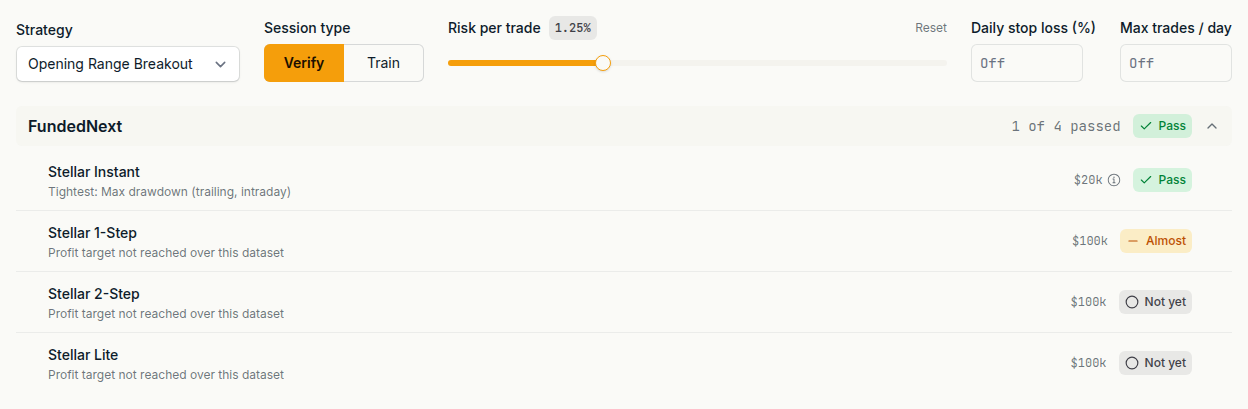
ChartLabs is a scorer, not a prop firm. It does not connect to FundedNext, place live trades or provide funding, and a pass in ChartLabs is not a pass with any firm.
Worth reading next: Prop Firm Backtesting: See Which Challenges Your Strategy Would Pass for how the scoring works, and Backtesting a Trading Strategy: A Beginner's Guide if you do not yet have a backtest to score.
Your next step: test your strategy against rule sets like these on cleaned data from Dukascopy, with a 7-day free trial. No credit card required. One plan, $20/month or $200/year.
Related Topics
Related Guides
Prop Firm Backtesting: See Which Challenges Your Strategy Would Pass
ChartLabs re-scores your backtested trades against real prop firm challenge rules, so you can see which challenges your strategy would pass and what sizing would change that. It is a scorer, not a funded account: ChartLabs does not connect to a prop firm, place live trades, or provide funding.
Backtesting a Trading Strategy: A Beginner's Guide
What backtesting is, why it matters, and how to run one step by step: defining your rules, choosing clean historical data, stepping through the chart trade by trade, logging results, and reading the metrics that tell you whether your strategy has a real edge.