Is the FTMO Challenge Free? The Free Trial, Explained
Is the FTMO Challenge free? No: FTMO prices the 2-Step from €89 and the 1-Step from €79. What the 14-day Free Trial is, and what the paid rules require.
No. The FTMO Challenge is a paid evaluation, and FTMO's own comparison table prices it: the 2-Step starts from €89 and the 1-Step from €79, for the smallest account each one offers. What is free is a different product with a similar name, the 14-day Free Trial, which FTMO calls "an abridged version of the FTMO Challenge experience" and sells as a way to "Assess your trading skills without entry fee".
FTMO's figures here were checked on 7 October 2026, and they cover the CFD products only. FTMO sells a separate Futures line with its own rules and its own prices, and none of those numbers are below.
Is the FTMO Challenge free, and what does it cost?
The Challenge is paid. The Free Trial is free. Those are two products with similar names.
FTMO runs the Challenge in two shapes, a 1-Step and a 2-Step, and prices them separately. Their comparison table gives the 2-Step as "Starts from €89" and the 1-Step as "Starts from €79". Larger account sizes cost more, up to the $200,000 account they advertise as their maximum.
The refund terms differ, and they are part of the price. On the 2-Step, the table marks the refund "Yes 100%". On the 1-Step it is marked with a dash, so there is no fee refund on that product. A trader comparing the two on headline price alone has the cheaper one backwards: the 1-Step costs €10 less with no refund attached, while the 2-Step costs €10 more and carries a full one. What that refund depends on is not stated on the table, so it is worth reading in their terms before you buy.
What is the FTMO Free Trial, and how long does it last?
Fourteen days. FTMO: "Traders can use our Free Trial demo account for 14 days. After this period, they can create a new one."
They give the purpose in their own words, which is to "allow new clients to familiarise themselves with our trading environment and tools, and to assess their trading approach". The trial carries "most of our proprietary applications, including the Statistical Application, Account MetriX, Trading Journal, and a shortened version of the Account Analysis".
Their Free Trial page names MetaTrader 4, MetaTrader 5 and cTrader among the platforms it runs on.
How do the Free Trial's rules differ from the paid Challenge?
The target is halved, and on the 2-Step the trial is shortened to a single phase. FTMO: "The rules are closely aligned with the paid version of the FTMO Challenge, although the required Profit Target is halved for the trial period."
The specifics, from their FAQ:
- The 2-Step trial is "limited to one phase", with "The Profit Target is reduced from 10% to 5%" and "The Minimum Trading Days requirement is reduced from 4 to 2".
- The 1-Step trial follows the 1-Step objectives, with "The Profit Target is reduced from 10% to 5%".
Everything else stays where the paid product has it.
What does the paid FTMO Challenge require?
A profit target, a daily loss limit and a maximum loss limit on both products, plus minimum trading days on the 2-Step and a best day rule on the 1-Step. From their comparison table:
| Rule | 2-Step | 1-Step |
|---|---|---|
| Phases | 2 | 1 |
| Profit target | Phase 1: 10%, Phase 2: 5% | 10% |
| Max daily loss | 5% | 3% |
| Max loss | 10% | 10% |
| Max loss type | Static | End-of-day trailing |
| Minimum trading days | 4 days | none |
| Best day rule | none | 50% |
| Trading period | Unlimited | Unlimited |
| Rewards | Up to 90% | 90% |
| Fee refund | Yes 100% | none |
The same 10% behaves differently on the two products.
On the 2-Step it is static. FTMO's objectives page: the limit is "the Initial Simulated Capital" minus "the Maximum Loss Amount, which is 10% of the Initial Simulated Capital". On a $100,000 account that is a floor of $90,000 that never moves, so every dollar you make is room you keep.
On the 1-Step it trails at the end of each day. The limit is recalculated daily from "the highest account balance achieved at 00:00 CE(S)T of any preceding trading day or, if higher, the amount of Initial Simulated Capital", minus the same fixed 10% of the starting capital. FTMO's own worked example on a $100,000 account runs the floor from $90,000 on day one to $94,000 once a day has closed at $104,000, and it stays at $94,000 the next day even after a close at $103,000, because "The limit can only increase, but never decrease". FTMO names one exception, that "when a Reward is withdrawn and a new FTMO Account is provided, the Maximum Loss Limit fully resets, returning the first-day limit to 90% of the Initial Simulated Capital".
The amount subtracted is 10% of the starting balance, not 10% of the high, and the high the floor follows keeps rising. Take a $100,000 account that closes a month at $106,000: its floor is sitting at $96,000, which is below where it started. You can breach a 1-Step account while still being up on the month, as long as you gave back more than 10% of the original capital from your best close. A static 10% cannot do that to you.
Our drawdown calculator does that give-back arithmetic on a balance you type in, which is quicker than keeping two floors in your head.
The 1-Step also carries the best day rule, which the 2-Step does not: "the Best Day Rule requires that your Best Day does not represent more than 50% of your Positive Days' Profit". Breaking it is not fatal. FTMO: "Exceeding the Best Day limit is not treated as a rule breach. However, you need to continue trading to generate additional profit until your Best Day (the most profitable day) represents 50% or less of your Positive Days' Profit on the account." Their example has a trader make $10,000 of $16,000 on one day, which is 62.5%, and needing to reach $20,000 of positive days' profit before that day falls to half.
Can the Free Trial get you a funded account?
No, and FTMO says so in several places. "passing a Free Trial does not guarantee success in either the FTMO Challenge: 1-Step or the FTMO Challenge: 2-Step." "The Free Trial is intended as a preparatory experience and not as a qualification step." "Free Trials do not grant any eligibility to automatically secure an FTMO Account." And on the Free Trial page itself: "Free Trials of FTMO Challenge do not guarantee automatic eligibility for an FTMO Account".
Whatever the trial tells you, the paid product is the only route they publish to an FTMO Account.
How many Free Trials can you have?
One at a time, and you can replace it as often as you like. FTMO's FAQ: "Our Free Trials are extremely popular, with thousands of accounts created every day. To accommodate demand, only one Free Trial per client is allowed at a time." The Free Trial page adds: "Each trader is permitted only one Free Trial at a time (you can delete it and start a new one)". The call to action FTMO runs across its own site puts it as "As many Free Trials as you need".
You cannot run several at once, and nothing stops you running one after another.
What does "free prop firm challenge" usually mean elsewhere?
It means four different things, depending on who is writing. A guide at velotrade.com sets out the four and says plainly that "There is no single definition", listing a promotional free challenge as one of them: "A firm runs a limited-time campaign: free access to the evaluation for a set period, or 100% off for the first X signups. These are real but not permanent products."
The same guide warns: "Free or discounted offers often come with tighter rules, lower profit splits, or limited instruments". The thing to check about a free entry, then, is what the free version changes about the rules you have to trade inside once you are in it.
What can a 14-day demo tell you about a strategy?
How you trade in real time, on their platform, for one fortnight. What it cannot tell you is how your strategy behaves across market conditions, because fourteen days is one sample of one period.
There are things only a real-time test gives you: the platform's actual behaviour, the feel of waiting for a setup that may not arrive, whether you follow your own rules when nothing is happening, and how their tools report your results. FTMO built it for exactly that, to let a trader "familiarise themselves with our trading environment and tools".
What it leaves out is everything the next fortnight happens not to contain. If your strategy needs a trending market and those two weeks chop sideways, you learn very little about the strategy and quite a lot about your patience. The 5% trial target inside fourteen days shapes behaviour too: it is short enough that a flat first week invites exactly the forcing that loss limits punish. Two traders with identical rules can come out of two different fortnights with opposite conclusions.
Markets do not repeat, and a backtest over years of past data does not predict how an attempt would go either. What it does is show you whether the rules ever worked, across enough different conditions that one lucky or unlucky stretch stops deciding the answer.
How do you test a strategy against challenge rules without paying anything?
Backtest it by hand, then score the closed trades against the rule sets. That is the workflow ChartLabs is built for, and it runs on historical data, so a fortnight of market conditions takes an afternoon.
The backtest comes first. You step through historical charts bar by bar and place trades as if the market were live, which builds a set of closed trades with real entry and exit prices behind them. Depth is per symbol, up to around 22 years on the oldest forex pairs, with other instruments starting later, across forex, indices, commodities and crypto. The data comes from Dukascopy, tick-level where it is available, cleaned to remove anomalies, and converted to 1-minute candles.
Then the Prop Firms scorer. It takes the closed trades from a strategy you backtested and re-scores them against a read-only catalog of real challenge structures, checking the profit target, the daily loss limit, maximum drawdown in its static, trailing and trailing intraday forms, minimum trading days, consistency rules, time limits and weekend holding rules. Every verdict is Pass, Almost, Not yet or Failed, and each one names the single rule that held you back. A risk per trade control re-scales the same trades at a different size, so you can see how much of the outcome was your rules and how much was sizing.
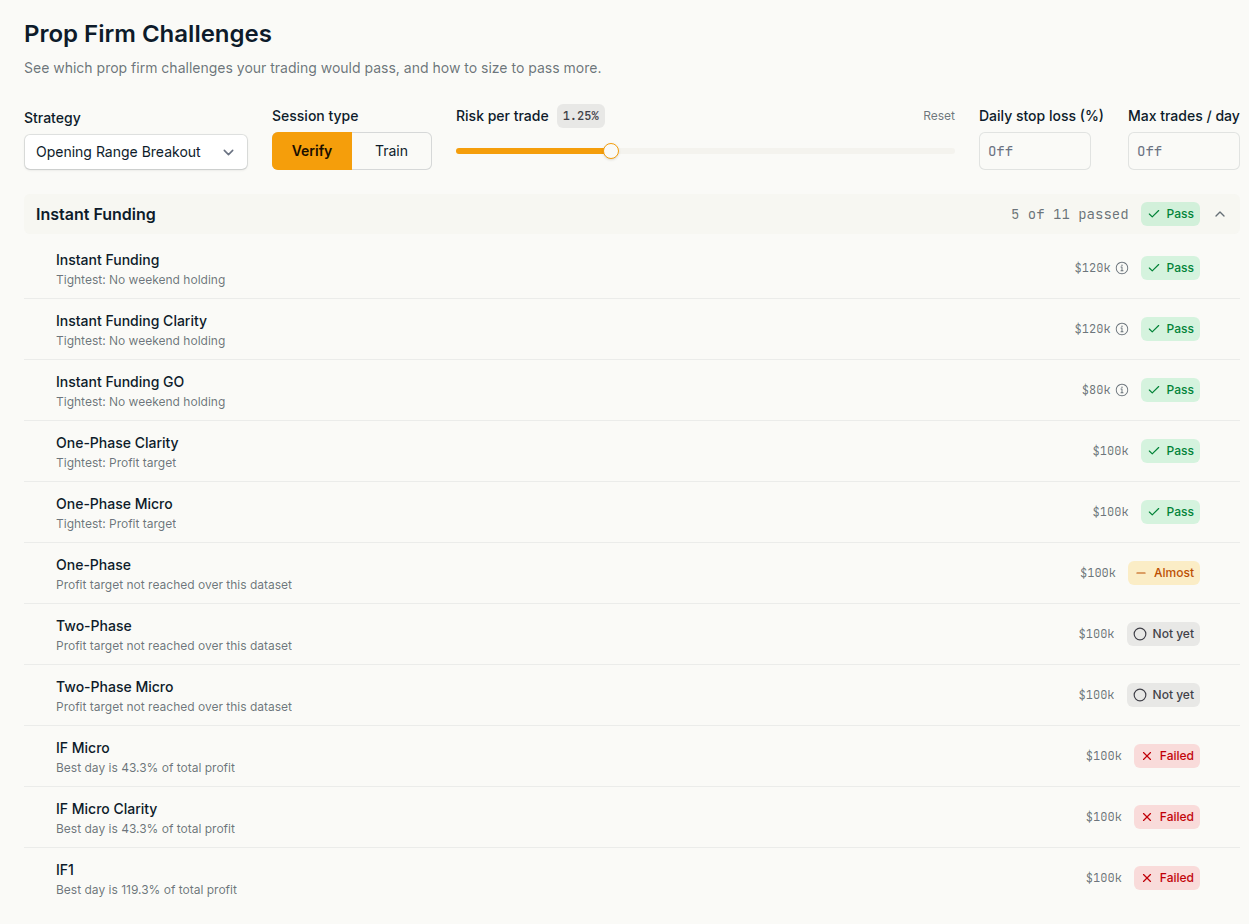
It is a scorer. ChartLabs provides no capital, has no connection to FTMO or any other firm, and a pass here is not a pass with anyone. It tells you what a rule set would have done to your trading before money or a fortnight is committed to finding out.
The three things, side by side
| FTMO Free Trial | FTMO Challenge | ChartLabs backtest | |
|---|---|---|---|
| Cost | no fee, "without entry fee" in FTMO's words | from €79 on the 1-Step, from €89 on the 2-Step | 7-day trial, no card, then $20 a month or $200 a year |
| Length | "14 days", one at a time, repeatable | "Unlimited" trading period on both products | as long as the history you test |
| What it tests | your trading in real time, on their platform | the same, as their paid evaluation | your rules across past conditions, then against rule sets |
| Market period | the next 14 days | the period you trade it | any period in the data |
| Fee back | nothing to refund | "Yes 100%" on the 2-Step, none on the 1-Step | no fee to refund |
| Leads to an account | "do not grant any eligibility to automatically secure an FTMO Account" | their published route to an FTMO Account | no, it is a scorer and we provide no funding |
Which one you want depends on the question you are asking. If the question is what their platform feels like, the trial answers it. If the question is whether your rules would have survived those limits, historical testing answers it faster and across more conditions.
Worth reading next
Backtesting vs paper trading covers the same trade-off in general terms: what a historical test and a real-time test each actually prove. The prop firm backtesting guide walks through how a strategy gets measured against challenge rules. If you have not run a manual backtest before, start with the beginner's guide.
Next step
Test the rules against your own trades first. Start the 7-day ChartLabs trial. No credit card, and the full plan while you test.
Tags
Related Articles
Backtesting a Trading Strategy: A Beginner's Guide
What backtesting is, why it matters, and how to run one step by step: defining your rules, choosing clean historical data, stepping through the chart trade by trade, logging results, and reading the metrics that tell you whether your strategy has a real edge.
Prop Firm Backtesting: See Which Challenges Your Strategy Would Pass
ChartLabs re-scores your backtested trades against real prop firm challenge rules, so you can see which challenges your strategy would pass and what sizing would change that. It is a scorer, not a funded account: ChartLabs does not connect to a prop firm, place live trades, or provide funding.
Backtesting vs Paper Trading: Which One and When
A practical comparison of the two ways to test a strategy without real money: what each one actually tests, when to reach for it, and why running the historical test first saves weeks of real-time work.