Backtesting vs Paper Trading: Which One and When
A practical comparison of the two ways to test a strategy without real money: what each one actually tests, when to reach for it, and why running the historical test first saves weeks of real-time work.
Both backtesting and paper trading let you test strategies without risking money. But they work differently, serve different purposes, and most traders benefit from using both, in the right order.
What's the Difference?
Backtesting tests a strategy against historical data. The market has already happened. You're looking backward to see how your strategy would have performed across years of known price action.
Paper trading (also called demo trading or forward testing) tests a strategy on live market data in real time, but with virtual money. The market is happening now. You're trading live conditions without financial risk.
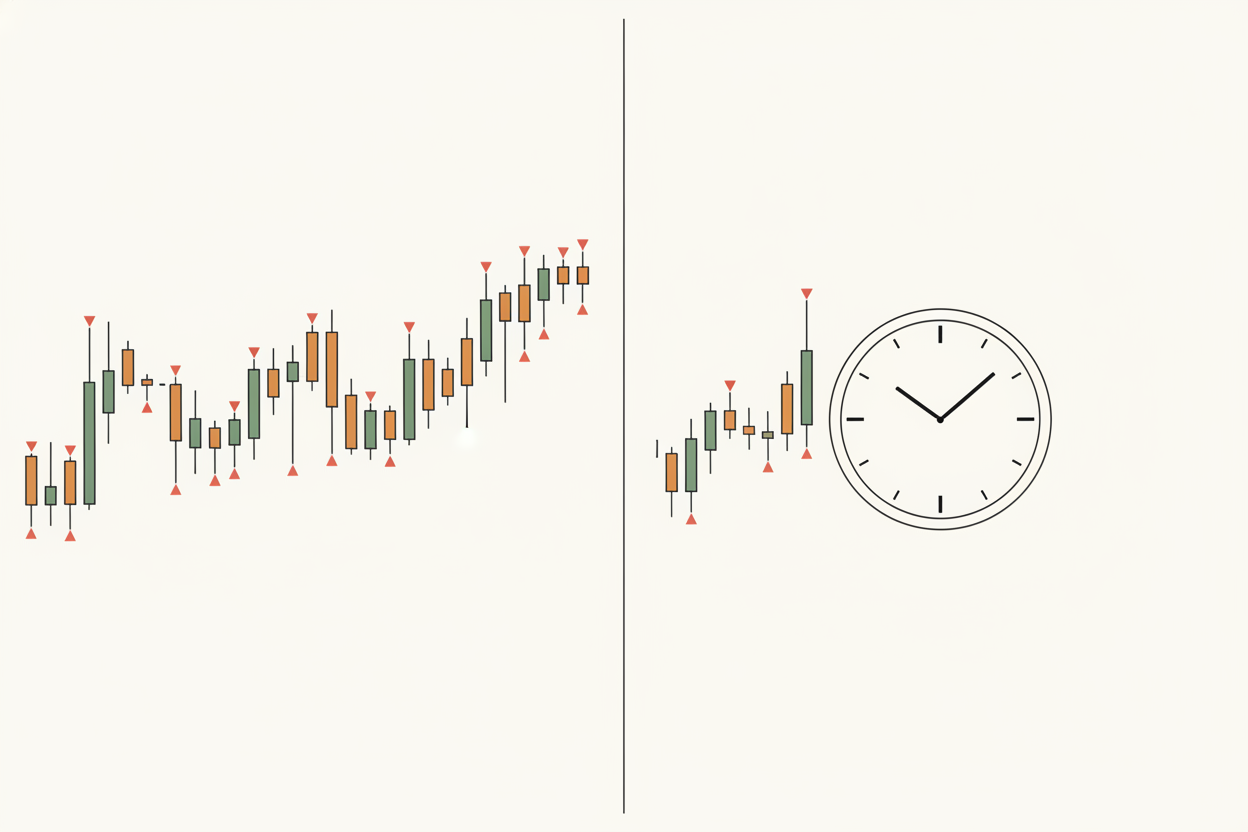
The key distinction: backtesting compresses time. You can test a strategy across 10 years of data in a few hours. Paper trading runs in real time. Testing that same strategy over 10 years would take 10 years.
When to Backtest
Backtesting is for strategy validation and practice. Use it when:
You have a new strategy idea. Before committing weeks to paper trading (or worse, real money), backtest it on historical data. Within a few hours, you'll know if the strategy has any statistical edge at all.
You need statistically significant results. A meaningful test requires hundreds of trades. Manual backtesting can generate this sample size in a fraction of the time paper trading would take.
You want to practice execution. Manual backtesting lets you practice placing trades, managing positions, and following your rules, repeatedly, across varied market conditions.
You're preparing for a prop firm challenge. You need to practice your strategy under specific conditions (drawdown limits, profit targets) and you can't afford to spend weeks paper trading when the challenge window is fixed.
You want to refine your strategy. Backtesting with trade tagging lets you isolate which setups work and which don't, then filter and refine before going live.
When to Paper Trade
Paper trading is for live market validation. Use it when:
Your backtest looks promising and you're ready to test in real-time conditions. Backtesting uses historical data. Paper trading confirms your strategy works with live spreads, real-time price action, and current market dynamics.
You need to practice live execution. Backtesting simulates market speed, but live markets have real-time pressure: news events, sudden volatility, the emotional weight of watching price tick by tick.
You're transitioning to a new market or instrument. Paper trading lets you get comfortable with the live behavior of an asset class you haven't traded before.
You want to test your routine. Paper trading validates your entire trading workflow in real conditions: screen time, session timing, decision-making speed.
Why Order Matters
The most efficient workflow is: backtest first, then paper trade.
Backtesting catches fundamental flaws fast. If your strategy loses money across 5 years of historical data, you've saved yourself weeks of paper trading a broken idea.
If backtesting shows promise (consistent profitability, manageable drawdowns, enough trade frequency), move to paper trading to validate against live conditions.
Going straight to paper trading with an untested strategy wastes time. You're running a slow test when a fast one would have given you the same answer sooner.
The Confidence Factor
Here's the part most traders overlook: backtesting builds confidence in a way that paper trading alone doesn't.
Paper trading in real time means you experience a few trades per week, maybe a few per day. Over months, you might accumulate 50-100 trades. That's a thin dataset and a slow feedback loop.
Manual backtesting on historical data lets you place hundreds of trades in a single session. You see your strategy perform across bull markets, bear markets, range-bound periods, and high-volatility events. You experience drawdowns and recoveries compressed into hours instead of months.
That volume of experience creates a level of familiarity with your strategy that paper trading alone simply can't match in a reasonable timeframe.
Summary
| Backtesting | Paper Trading | |
|---|---|---|
| Data | Historical | Live |
| Speed | Compressed (years in hours) | Real time |
| Sample size | Hundreds of trades quickly | Slow accumulation |
| Best for | Validation, practice, refinement | Live condition testing, routine building |
| When to use | First: test the idea | Second: confirm in live conditions |
| Confidence building | High (volume of experience) | Moderate (limited trades) |
Both, in the Right Order
The traders who are best prepared are the ones who backtest thoroughly and then paper trade to confirm. Backtesting does the heavy lifting: strategy validation, practice, and confidence building. Paper trading adds the final layer, live market confirmation.
Skipping backtesting and going straight to paper trading is like skipping practice and going straight to scrimmage. You'll learn eventually, but it'll take much longer and you'll develop bad habits along the way.
Start with backtesting. ChartLabs makes manual backtesting simple: clean historical data, full analytics, and a focused interface built for the work. 7-day free trial at chartlabs.io.