Crypto Backtesting: How to Test Your Crypto Strategy
Crypto's volatility, round-the-clock hours, and shifting market structure make backtesting harder than it is in forex. Here is how to test a crypto strategy properly: which pairs to start with, how to handle spread and regime changes, and what to look for in your results.
Crypto markets are volatile, 24/7, and full of traders who've never backtested a single strategy. That combination creates opportunity for anyone willing to do the preparation work.
Backtesting crypto strategies comes with challenges you don't get in forex or equities: less historical data, wilder price swings, and market behavior that has shifted a lot over a short history. But the core principle is the same: test before you trade.
Why Crypto Needs Backtesting
Extreme volatility. Bitcoin can move 10% in a day. A strategy that works in calm conditions might blow through your stop loss in crypto. You need to know how your strategy behaves during extreme moves, and backtesting is the only way to find out without learning the expensive way.
24/7 markets. Unlike forex, there's no session close. Crypto trades around the clock, every day. This means your strategy is always exposed. Backtesting across the available history reveals whether your approach handles that constant exposure or whether it needs session-based filters.
Shifting market structure. Crypto does not behave the same way from one cycle to the next. Liquidity changes, institutional participation changes, and correlations with traditional markets move around. Testing across more than one cycle shows how your strategy copes when conditions change.
Emotional intensity. The psychological pressure of crypto trading is extreme: FOMO during rallies, panic during crashes, the constant noise of social media. Manual backtesting builds emotional resilience by exposing you to these scenarios, in compressed time, before real money is at risk.
Crypto-Specific Backtesting Considerations
Data Availability
Crypto does not have the long history forex does. Coverage starts later, and how far back it goes varies from symbol to symbol, so check the depth on the pairs you actually trade before you plan a test.
We source data from Dukascopy, tick-level where it is available, and clean it to remove anomalies before building 1-minute candles. It is the same pipeline we use for forex and indices.
Spread and Liquidity
Crypto spreads are wider than major forex pairs, especially during volatile periods and for less liquid altcoins. A strategy that looks profitable ignoring spread might break even when realistic costs are applied.
Market Regime Changes
Crypto has gone through several distinct regimes: manias, crashes, long recoveries, and quiet ranging stretches. A robust strategy should perform across these regimes, not just during one favorable period.
Test across multiple market conditions. If your strategy only works during a bull market, you haven't tested a strategy. You have measured a trend.
How to Backtest Crypto Strategies
Step 1: Choose Your Pairs
Start with the majors. BTC/USD and ETH/USD have the most data and the tightest spreads. Once your strategy proves itself on majors, you can test on smaller caps.
Step 2: Define Clear Rules
Crypto's volatility makes it tempting to trade on instinct. Resist this. Define specific entries, exits, stop losses, and position sizes. The more rules-based your approach, the more meaningful your backtest.
Step 3: Test Across Different Periods
Don't just backtest on the latest rally. Include crashes, ranging periods, and low-volatility stretches. Your strategy needs to survive all of these.
Step 4: Use Manual Backtesting
This is especially important for crypto. The emotional intensity of crypto moves is part of the challenge. Manual backtesting, stepping through data candle by candle, placing trades, sitting through drawdowns, builds the psychological preparation that automated backtesting skips.
When Bitcoin drops 30% in your backtest and your strategy tells you to hold (or buy more), you get to practice that decision before it's your actual portfolio on the line.
Step 5: Analyze and Refine
Review your results with attention to maximum drawdown (crypto drawdowns can be severe), win rate across different volatility regimes, and whether your risk management rules held up during extreme moves.
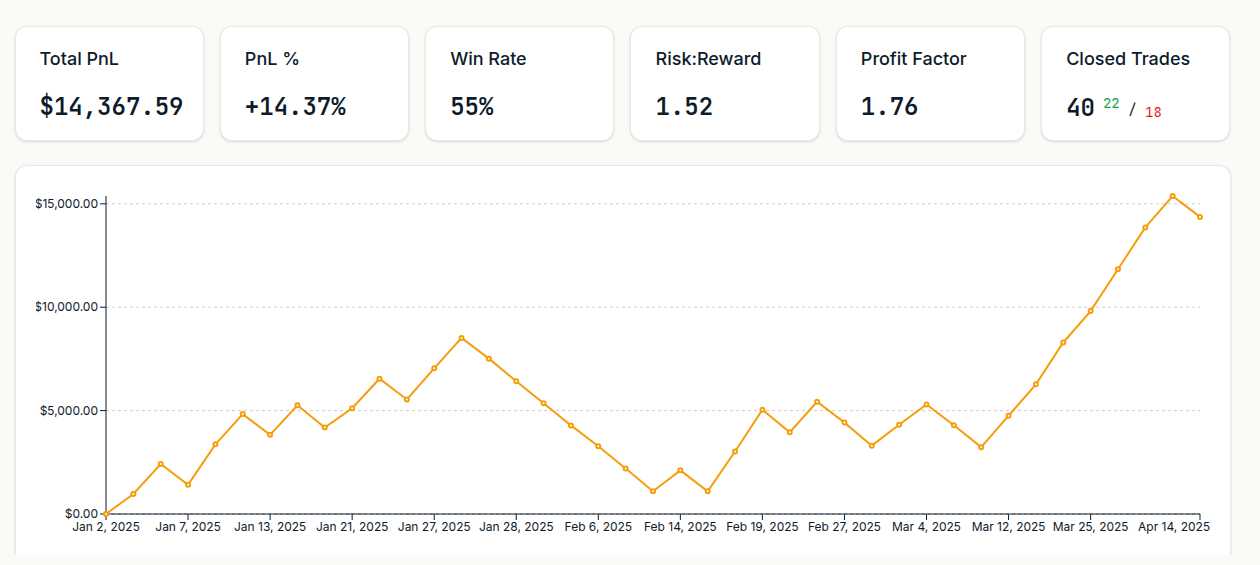
Tag your trades by market condition (trending, ranging, crash, recovery) and filter to see where your strategy performs best.
Getting Started
ChartLabs gives you clean crypto historical data with the same charting interface, analytics suite, and manual backtesting workflow used for forex and indices. Multi-screen charts, automatic trade snapshots, Monte Carlo simulation, and trade tagging are all included for $20/month, or $200/year.
7-day free trial. No credit card required. Start at chartlabs.io.